Generative occupancy & world models
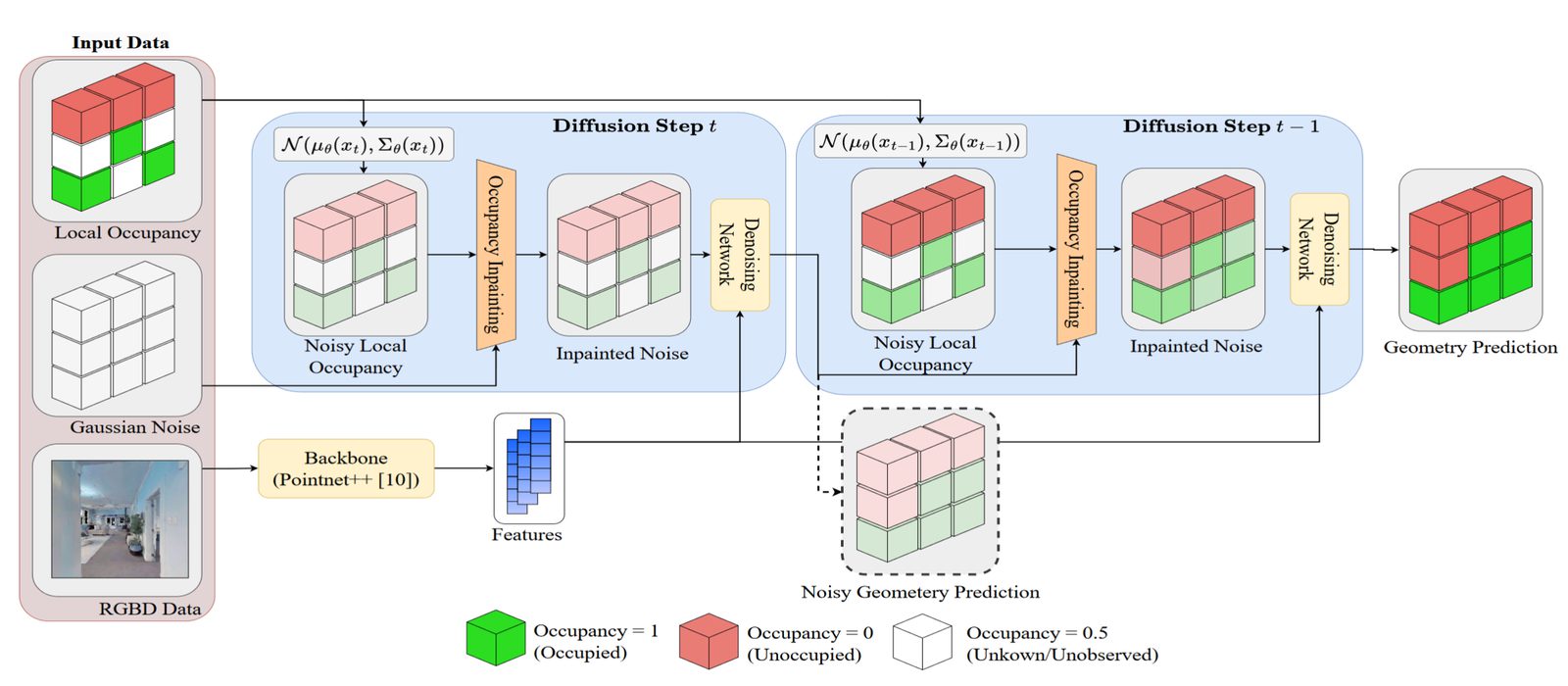
Diffusion models that complete a 3D scene from partial observation, so a robot can plan against what is probably there rather than only what it has already seen.
Read more →
PhD Student · CU Boulder
I build multi-modal perception for autonomous systems — teaching machines to see, predict, and act in environments they have only partly observed.
Research directions
Diffusion models that complete a 3D scene from partial observation, so a robot can plan against what is probably there rather than only what it has already seen.
Read more →Predicting where a carried object belongs in a home from the room layout, the person carrying it, and what little is known of their routine, so a robot can tidy or assist without being told where things go.
Read more →Fusing RGB-D, LiDAR, and RF signals into scene understanding that holds up in the cluttered, egocentric, partly-observed conditions real robots actually operate in.
Unifying perception, language, and control so that grounded instructions become safe, explainable decisions on a real platform.
Watch the talk →Distributional reinforcement learning models the whole spread of outcomes rather than the expected return, so a quadruped can learn locomotion and navigation policies that account for risk directly.
Read more →Selected publications
All publications →In review2026
3,805 human-annotated object-carrying episodes across 159 floors of 115 HM3D scenes. No single input modality is enough to predict where an object belongs.
In review2026
Across 480+ simulated cave environments, cut distance travelled by up to 58% and exploration time by up to 52%.
ICRA2025
IEEE International Conference on Robotics and Automation (ICRA)
73% faster runtime with minimal accuracy loss, extending prediction across the whole map rather than just around the robot.
Recent news
All news →